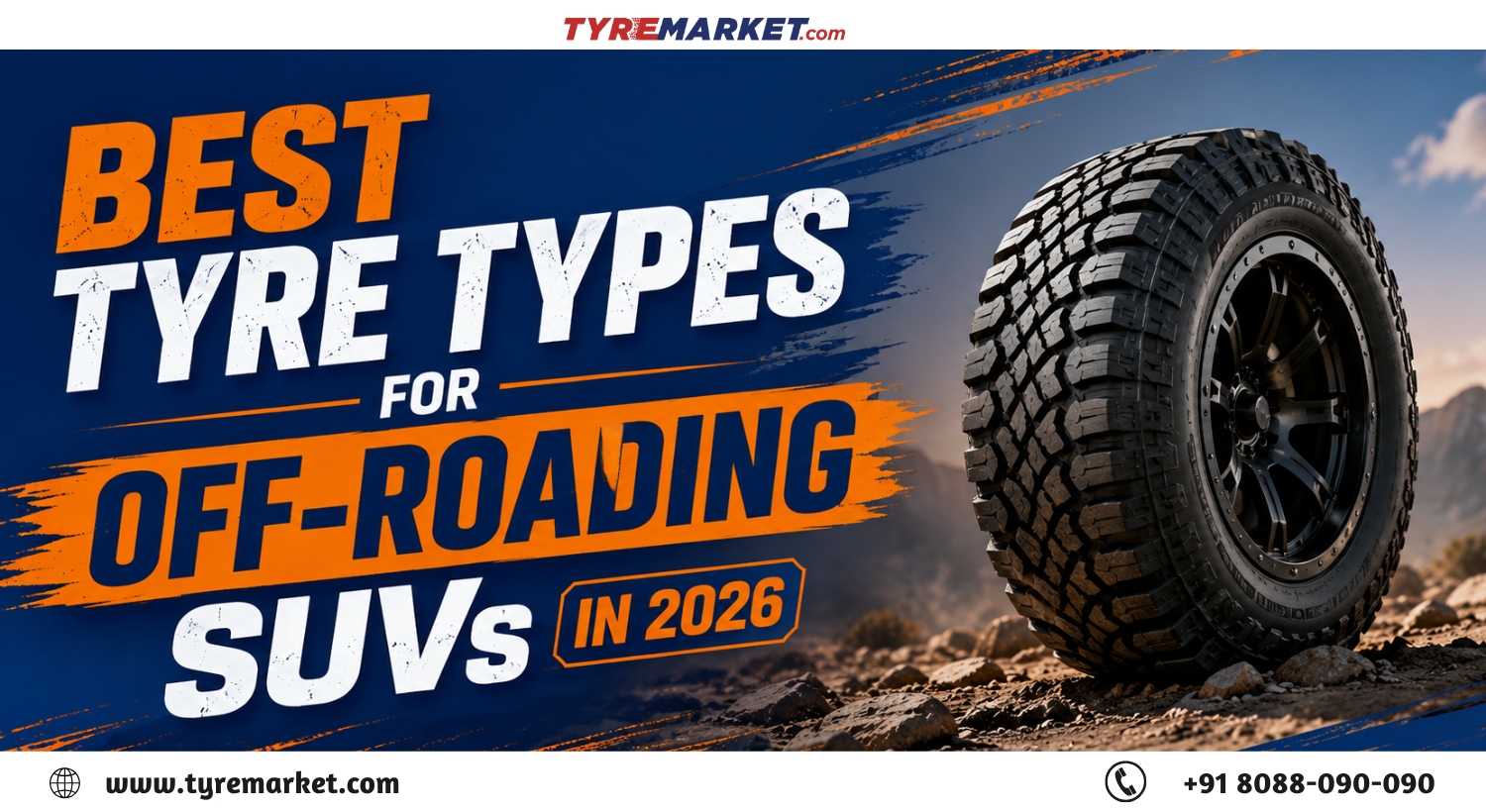
Best Tyre Types for Off-Roading SUVs in 2026

When you leave the smooth tarmac and venture onto challenging, unpredictable paths, standard highway terrain tyres quickly become the weak link. To fully unlock your vehicle’s potential, choosing the best off-road SUV tyre type is essential. That’s because selecting the correct tyre type ensures your tread can bite into shifting ground, resist sharp debris, and clear it out before it compromises control.
Among today’s leading options, CEAT’s SUV tyre range offers dependable solutions for drivers seeking a balance of everyday usability, durability, and off-road capability.
This extensive guide breaks down the dominant off-road tyre categories for 2026, explores critical engineering metrics, and helps you select the perfect match for your driving profile.
The Big Three: Off-Road Tyre Categories Explained
In order to navigate the market effectively, off-road tyres are engineered into three distinct categories based on their design intent and structural makeup. Choosing the right one comes down to a realistic assessment of your mileage split between paved motorways and rugged terrain.
1. All-Terrain (A/T) Tyres: The Balanced 70/30 Multitasker
For the vast majority of SUV owners, 4×4 all-terrain tyres 2026 represent the perfect compromise. These are engineered for an approximate split of 70% on-road driving and 30% off-road exploration.
- Tread Architecture:
A/T layouts utilise interlocking tread blocks with moderate void spaces. They incorporate dense siping (tiny micro-grooves within the tread blocks) that delivers reliable wet-weather adhesion and winter capability on paved surfaces.
- Best Suited For:
Daily commuting, regular highway cruising, light greenlaning, loose gravel tracks, hard-packed dirt, and farm trails.
- In-Class Benchmarks:
The market offers exceptional patterns engineered specifically for premium stability and high mileage. Among them, the highly durable CEAT CrossDrive AT uses specialised zigzag circumferential grooves to rapidly evacuate surface water, substantially minimising the risk of aquaplaning while preserving steering feedback on difficult trails.
Other notable options include the Apollo Apterra AT2, which features a unique multi-directional tread pattern with saw-tooth shoulder technology, making it incredibly quiet on highways while retaining excellent stability on loose sand and mud.
Another highly reliable option for long-lasting mixed-use durability is the Yokohama Geolandar A/T G015, which uses advanced silica compounds to resist cuts and chips on sharp stone paths.
2. Rugged Terrain (R/T) Tyres: The 50/50 Aggressive Hybrid
If your weekend excursions frequently involve rocky valleys or unmaintained overlanding routes, standard all-terrain options might leave you wanting more protection. This is where rugged-terrain tyres (often classified as hybrid tyres) come in.
- Tread Architecture:
R/T models merge the best characteristics of both worlds. The centre tread pattern remains tightly grouped to minimise the punishing highway drone typical of mud tyres. However, the outer shoulders feature massive, wide-void blocks designed to scoop through deep ruts and claw over jagged obstacles.
- Best Suited For:
Serious overlanding expeditions, rugged rock trails, heavy gravel paths, and drivers who demand a bold, aggressive aesthetic without totally sacrificing civilised on-road manners.
- In-Class Benchmarks:
While CEAT’s CrossDrive AT remains a strong choice for SUV owners seeking a balance between everyday driving and off-road capability, drivers who regularly tackle more demanding terrain may also consider specialised rugged-terrain options available across the broader market.
A prominent example is the Radar Renegade RT+, which features a computer-optimised dual-tread design, granting drivers an incredibly functional layout. Its wide lateral grooves and robust stone-ejector blocks ensure superior mud evacuation and outstanding damage resistance on demanding tracks, while keeping asphalt roar completely under control.
3. Mud-Terrain (M/T) Tyres: The Hardcore 15/85 Specialist
When analysing the classic mud-terrain vs all-terrain debate, it is clear that Mud-Terrain tyres are highly focused specialists. Engineered for roughly 15% on-road and 85% off-road conditions, they are uncompromised tools for extreme environments.
- Tread Architecture:
M/T patterns feature huge, deep tread blocks separated by massive void ratios. They include integrated stone ejectors, raised rubber ridges within the grooves that flex to push out stones and thick mud before the drill can reach the carcass.
- Best Suited For:
Deep clay, waterlogged bogs, steep rock crawling, and dedicated trail rigs.
- The Trade-off:
On the motorway, the large void gaps generate a noticeable low-pitched hum, increase rolling resistance (which affects fuel economy), and result in longer stopping distances on slick tarmac due to a smaller rubber contact patch.
- In-Class Benchmarks:
For drivers whose off-road requirements extend beyond the capabilities of an all-terrain tyre such as the CEAT CrossDrive AT, several specialised mud-terrain options are available for extreme conditions.
For example, the Yokohama Geolandar M/T G003 relies on a specialised triple-polymer compound that delivers high cut-and-chip resistance, complemented by aggressive side blocks to reduce puncture risk on sharp rock walls.
Technical Metrics to Look For Before Buying
To maximise your SUV’s off-road tyre performance, you must look beyond the tread pattern and evaluate the core engineering indicators built into the tyre’s internal structure.
- Sidewall Ply Rating & Carcass Construction
Off-roading frequently requires “airing down,” which means lowering your tyre pressure to around 15–20 PSI to lengthen the contact patch and let the rubber mould over obstacles. When deflated, the tyre’s sidewalls bulge out, making it vulnerable to sharp rocks and roots. Look for heavy-duty carcasses with reinforced construction (such as 3-ply polyester sidewalls or high-modulus casing plies) to prevent terminal punctures.
- Tread Void Ratio and Self-Cleaning Capabilities
A tyre can only provide traction if its tread can grab the surface. When driving through wet clay, a standard tyre’s grooves fill up instantly, turning it into a slippery racing tyre with zero grip. High-void off-road designs rely on centrifugal force and tread flexing to eject debris automatically as the wheel rotates, keeping the biting edges completely clean for the next revolution.
- Advanced Cut-and-Chip Resistant Compounding
Off-road rubber compounds must be extremely durable. Leading manufacturers inject highly engineered silica complexes into the rubber matrix. This technology assures the blocks remain flexible enough to conform to bumpy rocks while resisting “chunking,” the tendency of sharp gravel to tear pieces of rubber completely off the tread face during high-torque climbs.
Master Comparison Matrix
To help you visualise how these three categories stack up across critical operating parameters, review the balanced comparison matrix below.
| Operating Parameter | All-Terrain (A/T) | Rugged Terrain (R/T) | Mud-Terrain (M/T) |
| Primary Mileage Split | 70% On-Road / 30% Off-Road | 50% On-Road / 50% Off-Road | 15% On-Road / 85% Off-Road |
| Mud & Loose Soil Traction | Moderate to Good | Very Good | Exceptional |
| Jagged Rock Protection | Standard Casing | Reinforced Sidewalls | Heavy-Duty Armoured Plies |
| Motorway Noise Level | Very Quiet / Low Hum | Moderate Bass Drone | Noticeable / Loud Road Hum |
| Wet Tarmac Braking Safety | High Resistance | Moderate Grip | Longer Stopping Distances |
| Expected Tread Life | 80,000 – 100,000 km | 65,000 – 80,000 km | 50,000 – 65,000 km |
Conclusion
Choosing the ideal off-road tyre configuration requires matching your choice to your actual driving habits rather than aspirational aesthetics. While a set of aggressive mud-terrain tyres looks fantastic on a lifted SUV, installing them on a vehicle that spends most of its time on asphalt commutes will compromise fuel efficiency, wet-braking safety, and cabin acoustics.
For the daily driver who loves spontaneous weekend detours, a modern, highly optimised all-terrain model offers the smartest combination of on-road safety and off-road freedom. In this category, the CEAT CrossDrive AT stands out as a well-rounded option, combining dependable wet-weather performance, everyday comfort, and off-road capability for a wide range of SUV applications.
Always check your SUV’s manufacturer guidelines regarding load indices and speed ratings before upgrading to a heavy-duty pattern.
Frequently Asked Questions
- Can I run Mud-Terrain tyres year-round for normal daily commutes?
While it is legally and mechanically possible, it is generally not recommended for primary city or motorway driving. The massive tread blocks and wide voids reduce the total rubber surface area in contact with dry or wet tarmac. This results in longer braking distances, reduced fuel efficiency due to high rolling resistance, and a persistent, loud road hum that can quickly become tiring over long journeys.
- Why is “airing down” necessary when off-roading, and which tyre handles it best?
Lowering tyre pressure decreases internal inflation pressure, allowing the tyre to flatten out slightly. This significantly increases the contact patch’s length and width, distributing the vehicle’s weight more evenly over loose ground such as sand or soft mud. Reinforced options, including heavy-duty R/T and mud-terrain models, feature robust sidewall casings that safely withstand this extreme flexing without pinching or splitting.
- Do off-road tyres drastically reduce my fuel economy or the range of my electric vehicle (EV)?
Yes, switching from a highway touring tyre to an aggressive off-road tyre will noticeably affect efficiency. The deep patterns, heavier internal steel plies, and wide block voids require more energy to rotate and overcome rolling resistance. On average, switching to an aggressive all-terrain tyre can reduce fuel economy by 3% to 5%, whereas switching to a full mud-terrain tyre can result in a 7% to 10% decrease in fuel economy.