How Riding Style Changes Tyre Wear on Indian Roads

You might’ve wondered why some bikers, running the same tyre, seem to have much deeper tread after six months as compared to you.
While Indian road conditions, such as heat and surface texture, play a major role, the most significant variable is often the rider. Your riding style and tyre wear are inextricably linked, so every twist of the throttle and grab of the brake lever is a physical transaction with the road.
Understanding these dynamics is key to avoiding premature bike tyre wear in motorcycles. Whether you are a relaxed cruiser or someone who enjoys high-speed cruising, your driving style determines how much heat is generated and how much rubber is sacrificed. Here is a technical look at how different riding habits physically transform your tyres.
1. Linear Acceleration and “Micro-Slippage”
If you enjoy pinning the throttle the moment the signal turns green, you are engaging in the most common form of tyre wear. When high torque is suddenly applied to the rear wheel, the rubber undergoes “micro-slippage.” At a molecular level, the tread blocks stretch and snap back, generating intense localised heat.
Over time, this “shaves” the tread blocks. To counter this, performance-oriented rubber, such as the Tri-Polymer compound in the Eurogrip Protorq series, is engineered with a high-tensile molecular structure. This structure allows the rubber to resist the tearing forces of rapid acceleration. However, even the most advanced compound cannot fully offset the cost of a “heavy” right wrist.
2. Harsh Braking and the Friction Cost
When you brake, you generate friction between the tyre and the road, which, in itself, is manageable. However, harsh braking puts too much pressure on the front tyre’s contact patch as the bike’s weight shifts forward.
If the braking is aggressive enough to trigger ABS or cause a slight skid, the friction can reach temperatures high enough to physically soften the rubber beyond its intended operating range.
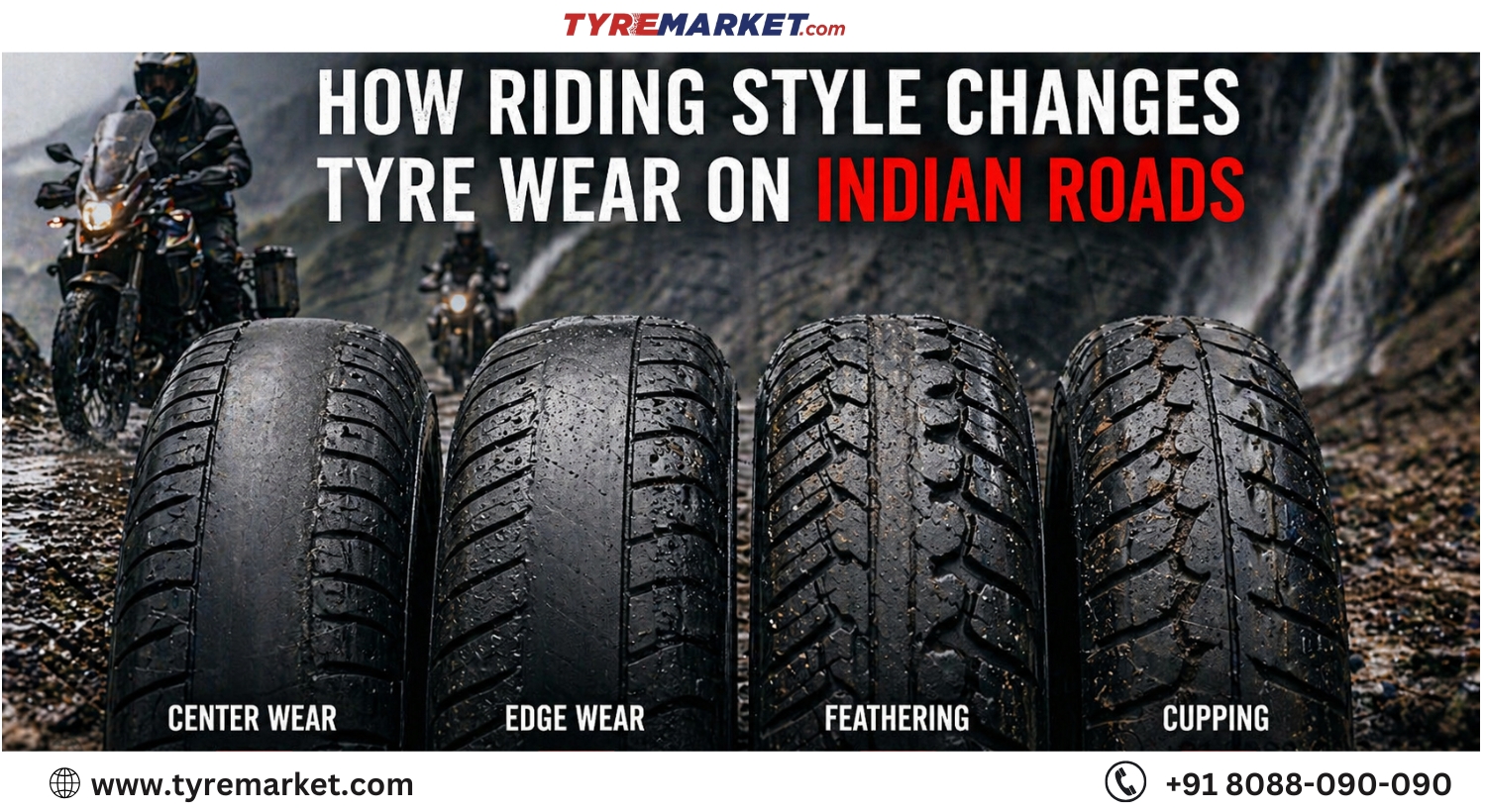
This practice can cause “cupping” or “scalloping,” resulting in uneven tyre wear around its circumference. In extreme cases, panic braking can cause flat spots. While tyres like the Eurogrip Jumbo GT feature a reinforced carcass to help the tyre maintain its round shape under these heavy loads, consistent aggressive braking will inevitably lead to a vibration-heavy ride as the tyre loses its perfect circularity.
3. The “Squaring Off” Effect in City Traffic
Most Indian riders spend 90% of their time riding in a straight line through traffic. Driving only in a straight line can lead to your tyre “squaring off,” where the tyre’s centre becomes flat while the shoulders remain untouched. It happens because the heat is concentrated in a narrow strip, causing the rubber there to degrade faster.
Ironically, riders who never lean their bikes into corners are actually shortening the “feel” and agility of their tyres. To mitigate this, many modern tires utilize Dual Compound Technology.
For instance, the High-Structure Carbon in the Eurogrip Roadhound is concentrated in the center to resist abrasion from straight-line highway cruising. At the same time, the shoulders remain softer for a cornering grip. By being aware of your lean angles, you can actually ensure more uniform wear across the entire profile.
4. Cornering Intensity and Thermal Management
For the spirited rider, cornering is where the tyre faces its toughest test. When you lean into a turn, the forces are applied laterally on the tyres. This puts immense pressure on the tyre’s sidewalls and shoulders, creating “tyre scrub” in which the rubber is literally dragged across the asphalt.
If you are a “sporty” rider, you will notice the shoulders of your tyres looking “balled up” or fuzzy, which is a sign of high thermal stress. Tyres like the Eurogrip Protorq Extreme use a specialized Profile Geometry to increase the contact patch as the lean angle increases. This design distributes friction over a larger area, helping manage heat and preventing the edges from melting prematurely.
Summary: Riding Habits vs. Tyre Impact
| Riding Habit | Primary Impact | Recommended Technical Solution |
| Aggressive Starts | Rear center wear / Tearing | High-Tensile Tri-Polymer Compounds |
| Harsh Braking | Front scalloping / Cupping | Reinforced Carcass Construction |
| Constant Straight Lines | Squaring off | Multi-compound / High-Structure Carbon |
| High Lean Angles | Shoulder wear / Heat buildup | Rounded Profile Geometry |
Conclusion
Your tyres are a direct reflection of your personality as a rider. While factors affecting motorcycle tyre life include everything from air pressure to road temperature, your riding style remains the most controllable variable. By opting for a smooth, progressive approach to the throttle and brakes, you can significantly extend the life of your rubber.
Choosing a tyre that matches your style, whether it is the highway-optimised Eurogrip Roadhound or the city-tough Jumbo GT, ensures the rubber’s chemistry works with you, not against you.
Ultimately, a balanced riding style doesn’t just save you money, but also ensures your tyres provide the cornering grip on Indian roads that you need when an emergency actually arises.
FAQs
- Does a “break-in” period really affect long-term wear?
Yes. During manufacturing, the coating from the mould can leave a slippery chemical coating on the tyre. Riding aggressively in the first 100 kilometers can cause “glazing”, leading to inconsistent wear patterns for the rest of the tyre’s life.
- Why does my rear tyre wear twice as fast as the front?
The rear tyre is the “workhorse.” It handles 100% of the acceleration and usually carries about 60-70% of the total weight (including the rider). This combined load means it will almost always wear out faster than the front.
- Does riding with a pillion change the wear pattern?
Yes, the extra weight of a pillon can flatten the tyre’s profile, increasing the contact patch with the road and the heat generated. If you frequently ride with a pillion, it’s important to increase your tyre pressure to prevent premature wear at the tyre’s centre.
- Can the road surface alone cause premature wear?
Yes. Concrete roads, common in many Indian cities, are far more abrasive than asphalt. If you ride aggressively on concrete, expect your tyre life to drop by 15-20% compared to smooth highway asphalt.
- How do I know if my riding style is too “aggressive” for my tyres?
Look at the “grain” of the rubber. If the edges of the tread grooves look “feathered” or raised, it’s a sign that you are braking or accelerating too hard, causing the tread blocks to distort and wear unevenly.