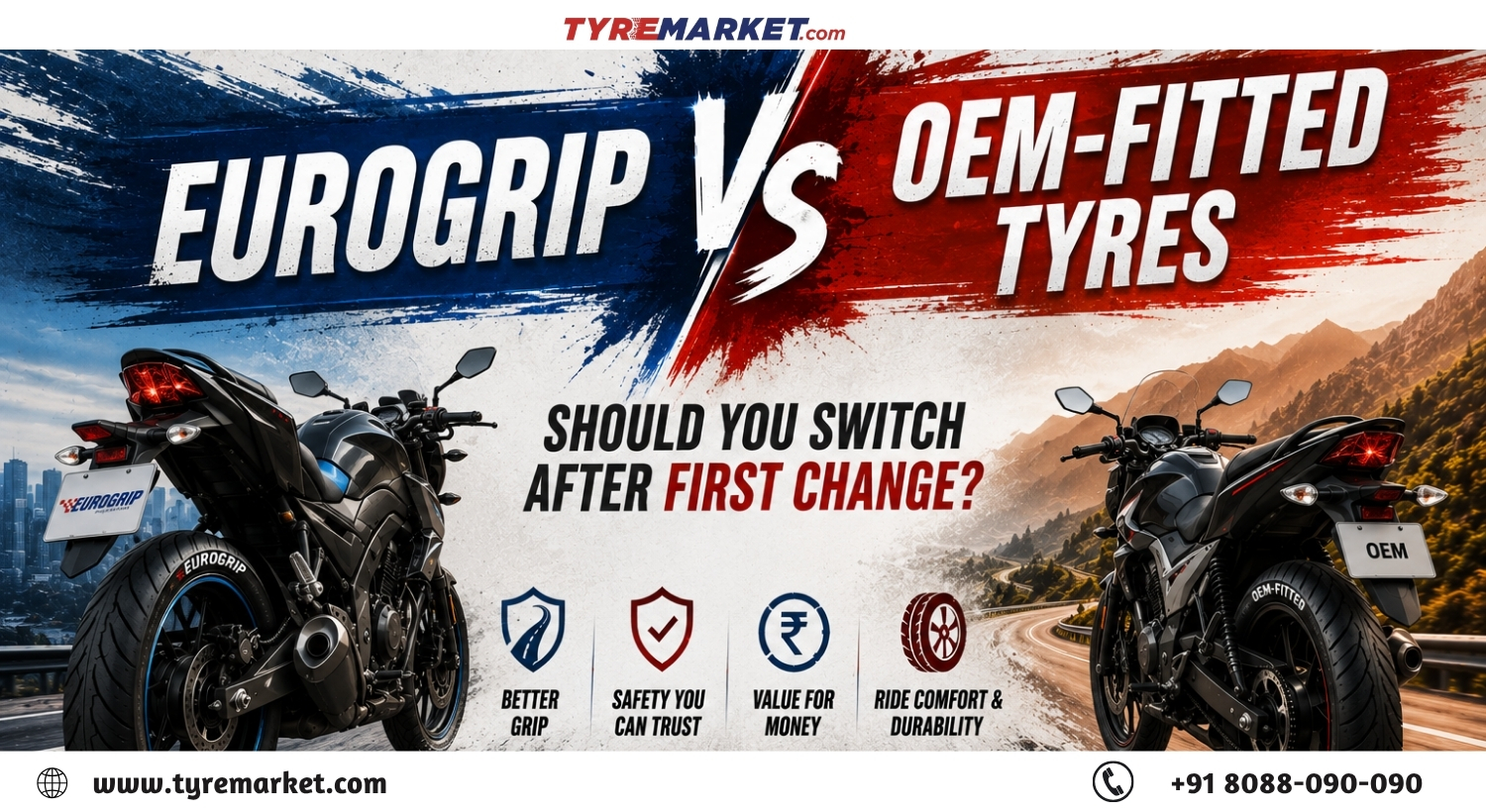
Eurogrip vs OEM-Fitted Tyres: Should You Switch After the First Change?

Key Takeaways
- No major Indian two-wheeler maker, including Honda, Hero, Bajaj, and TVS, uses a single tyre brand across all their two-wheeler models. OEM fitments can vary by batch, dealer and region, so there isn’t one fixed brand to switch from.
- Tyre size and construction usually stay consistent across a model’s generations even when the OEM brand changes, so switching brands at replacement time doesn’t usually mean a size change.
- Eurogrip plays two different roles depending on the vehicle: a same-size aftermarket option on models like the Honda Activa (Pancer II) and TVS Jupiter, and the actual factory-fitted tyre on models like the Aprilia SXR 50 (Conta 545) and RS 457/Tuono 457 (Protorq Extreme HR).
- The real question at first replacement isn’t Eurogrip versus one specific OEM brand. It’s about whether to stick with whatever came stock or deliberately choose a tyre based on how you actually ride.
Tyres are meant to last, but they do not last forever. Constant wear and tear, potholes, traffic conditions, and rough driving conditions put constant stress on the tyres, leading to premature wear and tear and leaving the tyres unsafe for driving.
When a scooter or motorcycle’s first set of tyres finally wears down, most riders face a decision they didn’t think much about at purchase. Should you replace the tyres with the same OEM brand, or switch to a different brand?
This decision comes up for nearly every rider eventually, and the honest answer starts with understanding what “OEM” actually means.
What “OEM-Fitted” Actually Means
OEM stands for original equipment manufacturer, the tyre a vehicle comes fitted with from the factory. Across India’s two-wheeler market, that doesn’t mean there’s a single tyre brand for every unit of a given model.
Industry coverage of India’s two-wheeler component ecosystem confirms that Indian two-wheeler makers source tyres from several suppliers instead of relying on one exclusive brand. MRF, CEAT, Apollo, Eurogrip and others supply OEM or OEM-matched tyres across different models, while the fitment on a particular bike can vary by batch, dealership and region. It is therefore quite possible for two riders with the same model to have different tyre brands fitted from the factory.
Take the Honda Activa as one common example. Riders frequently ask whether they should stick with the tyre it came with or switch to an aftermarket option when it’s time to replace it. The honest answer is that there often isn’t one single “original” tyre to compare against in the first place.
OEM fitment on the Activa itself varies by batch, with brands like MRF and CEAT commonly supplied alongside others. What does stay consistent across nearly every Activa generation, from the 3G through the current 6G, and the Activa 125, is the tyre size and construction.
Most variants use a 90/100 R 10 tubeless tyre at the rear, with newer models pairing it with a 90/90 R 12 front tyre. Both tyres feature bias-ply construction instead of radial construction, which is the standard approach for scooters in this speed and weight range in India. The same pattern also holds across other popular models, where size and construction tend to stay fixed generation to generation, even as the OEM tyre brand itself changes.
Why the First Tyre Replacement Feels Different?
The first time a rider replaces their scooter’s tyres, there’s rarely a strong opinion involved. The OEM tyre did its job for 10,000 to 12,000 kilometres or so, and the instinct is often to simply replace it with whatever’s convenient, sometimes the same brand, sometimes whatever the local shop stocks.
That’s a reasonable approach if the OEM tyre‘s characteristics match the rider’s actual use of the scooter. But OEM tyre selection is generally optimised for cost and broad-market durability, not for any one rider’s specific commute, road conditions, or riding style. A rider who does most of their riding through waterlogged monsoon streets has different priorities than one who mostly rides on dry, well-maintained roads.
Where Does Eurogrip Fit at Replacement Time?
Eurogrip builds tyres to match OEM sizes across a wide range of scooters and motorcycles, so switching doesn’t usually involve a size compromise. On the Honda Activa specifically, the Pancer II is built in the exact OEM size used across Activa and Activa 125 variants, 90/100-10 53J.
The tyre features an interlocked tread pattern with sipes, combined with Eurogrip’s TriP, DuCT and D2T technologies, specifically aimed at improving grip, stability and tyre life. The tyre is optimised for the kind of daily scooter use most riders actually put their vehicle through, including city traffic, broken roads, and monsoon conditions.
On the TVS Jupiter, Eurogrip goes a step further by offering OEM-compatible tubeless tyres identical to those fitted at the factory, in the Jupiter’s stock 90/90-12 size across all variants. This isn’t a same-size aftermarket alternative. It’s the same specification built for the same manufacturing line.
Eurogrip’s OEM partnerships also cover scooters such as the Aprilia SXR 50. The Conta 545 was selected as its original equipment tyre for its balance of dry and wet grip, durability and ride comfort.
And on the performance side, the Protorq Extreme HR is the factory-fitted tyre on Aprilia’s RS 457 and Tuono 457 motorcycles, using a 0° steel belt, an advanced tri-polymer tread compound, and variable-pitch winding, an engineering choice an international manufacturer chose to build the motorcycle around, not just a compatible replacement.
Taken together, these examples show Eurogrip playing two different roles in the OEM conversation. On models like the Activa, it’s a same-size aftermarket option built specifically for Indian riding conditions, and on models like the Jupiter, the SXR 50, and the RS 457/Tuono 457, it’s the actual factory tyre the manufacturer chose from the start.
| Vehicle | Eurogrip Tyre | Role | Why It Was Chosen |
| Honda Activa / Activa 125 | Pancer II | Same-size aftermarket replacement | Interlocked tread, sipes, TriP/DuCT/D2T for Indian commuting conditions |
| TVS Jupiter | OEM-compatible tubeless range | Identical to factory-fitted spec | Built for city commutes, potholed roads and monsoon conditions |
| Aprilia SXR 50 | Conta 545 | Original equipment | Balanced dry/wet grip, durability and comfort |
| Aprilia RS 457 / Tuono 457 | Protorq Extreme HR | Original equipment | 0° steel belt, tri-polymer compound, variable pitch winding |
This changes how you should approach tyre replacement. Instead of asking whether to stay with the bike’s original brand, consider why the OEM tyre was selected and whether it suits the way you ride. A tyre developed for Indian riding conditions may be a better fit if your priorities are durability, grip or touring performance.
Should You Switch, or Stick With What Came Stock?
There’s no universal right answer here, but there is a useful way to think about it. If the OEM tyre performed well for your riding style and you never noticed any wet-weather grip issues, stability concerns, or premature wear, sticking with the same brand at replacement time is a perfectly reasonable, low-risk choice.
If, on the other hand, you noticed the OEM tyre struggled in the monsoon, wore unevenly from regularly carrying a pillion, or just didn’t inspire much confidence in daily traffic, the first replacement is exactly the right time to switch, since you’re not giving up anything in terms of fitment. A tyre like the Pancer II is a straightforward same-size swap, not a compromise.
Final Thoughts
The idea of “switching away from OEM tyres” makes the decision sound bigger than it usually is. Since most two-wheeler manufacturers don’t fit one consistent tyre brand across a model’s lifetime, there’s often no single incumbent to switch away from in the first place, and tyre size and construction usually stay the same across a model’s generations. This means the first replacement is really just a chance to choose deliberately instead of defaulting.
A tyre built in the correct OEM size, with technology aimed specifically at how you actually ride, gives riders a straightforward way to make that choice without any fitment trade-off, regardless if that’s the Eurogrip Pancer II on an Activa or an equivalent match on another scooter or motorcycle.
Whether that means switching or sticking with what came stock, the right call comes down to how the tyre you have now has actually performed for you.
FAQs
- Should I stick with original equipment tyres or switch to aftermarket ones?
It comes down to how the OEM tyre performed over the years in your usual riding conditions. If it offered good grip and stability in wet weather and daily traffic, there may be little reason to switch to a different tyre altogether. If those areas have been lacking, the first replacement is a good opportunity to choose a tyre suited to your riding style, while keeping the manufacturer’s recommended size.
- Should I stick with original equipment tyres or upgrade to aftermarket for my Honda Activa?
On the Activa specifically, OEM fitment already varies by batch, so there often isn’t one fixed brand you’re “switching away from.” If your current tyre handled monsoon riding and daily traffic well, sticking with it is fine. If not, the Eurogrip Pancer II is built in the Activa’s exact factory size, so switching doesn’t mean a fitment compromise.
- Does every two-wheeler manufacturer use one fixed OEM tyre brand?
No. Across Honda, Hero, Bajaj, TVS and other manufacturers, OEM tyre fitment can vary by manufacturing batch, dealership and region. Different tyre brands are supplied over time, so there is no single brand fitted to every unit.
- Is it safe to switch tyre brands when replacing my scooter’s tyres?
Yes, as long as the replacement tyre matches your scooter’s OEM size and construction type. Eurogrip’s Pancer II, for example, is built in the Activa’s exact factory size, so switching brands at replacement time doesn’t require any size or fitment compromise.
- How do I know if my current scooter tyre isn’t a good match for how I ride?
Signs include reduced confidence or grip during the monsoon, uneven tread wear if you regularly carry a pillion or extra load, or a general feeling of instability in traffic that didn’t improve with correct tyre pressure. Any of these are reasonable signals to choose your next tyre deliberately rather than defaulting to whatever’s convenient.