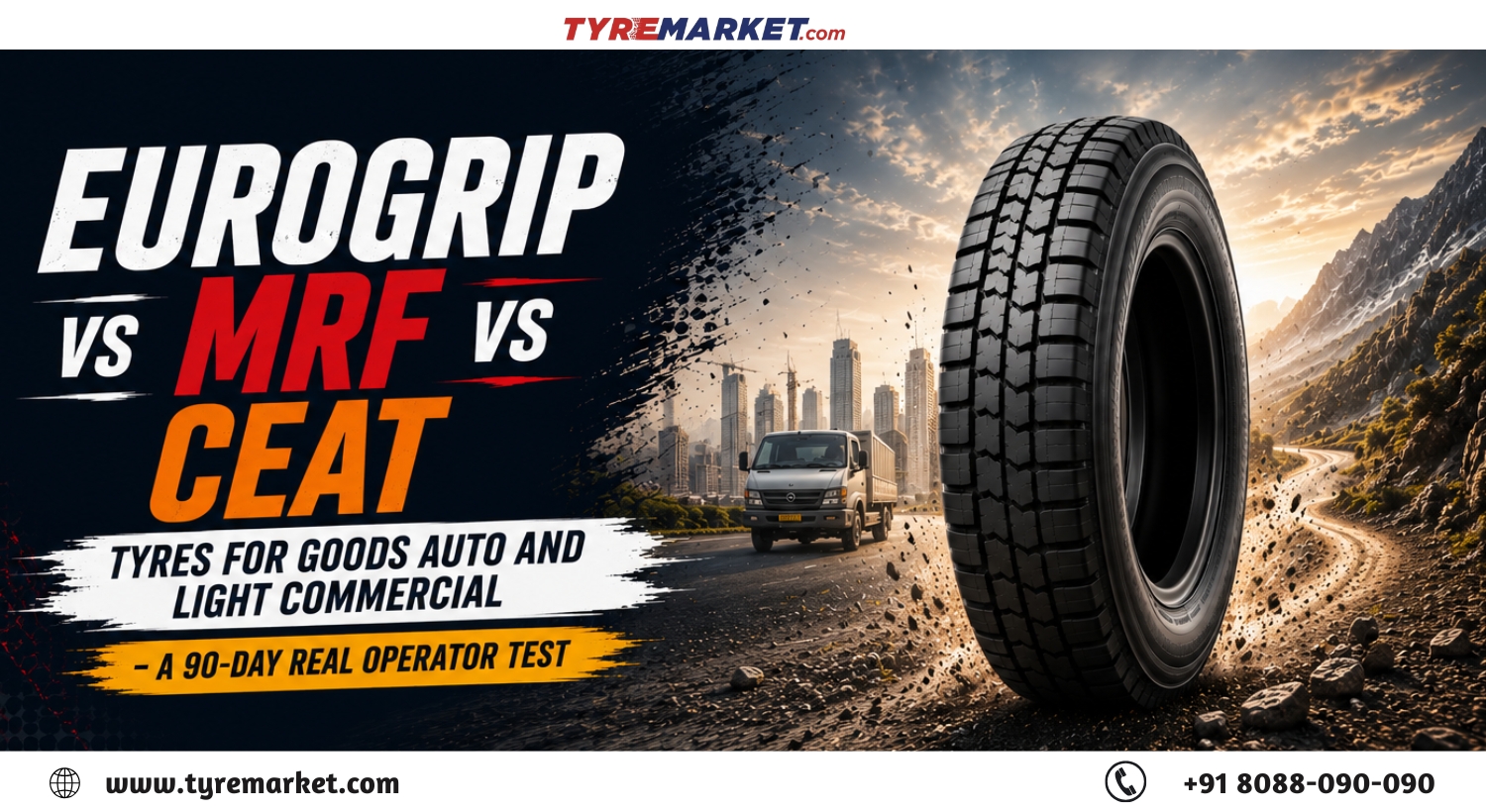
Eurogrip vs MRF vs CEAT – Tyres for Goods Auto and Light Commercial – A 90-Day Real Operator Test

Managing a commercial delivery fleet or running an independent transport business in India requires strict control over costs. Every single rupee spent on fuel and maintenance directly cuts into your daily earnings. Procurement of durable tyres is a critical factor determining whether a route remains profitable.
To understand how these commercial components perform under severe everyday pressures, we launched a 90-day field trial across complex distribution channels. Our evaluation tracked a collection of three-wheeler cargo vehicles and small delivery trucks running through demanding suburban corridors and crowded metropolitan wholesale markets.
This rigorous practical test evaluated three prominent choices in the Indian market, which are the TVS Eurogrip Badshah, the MRF Automiler 99, and the CEAT Buland series. Over three months, our operators monitored these products to identify the best tyre for vehicles such as Tata Ace units and standard cargo auto rickshaws.
Phase 1 – Heavy Payload Structural Resilience
Evaluating how modern goods auto tyres behave under extreme loading conditions requires a close examination of internal casing engineering. During our fleet study, our drivers focused exclusively on how well these casings handle maximum weight limits and sudden weight shifts during distribution runs.
The TVS Eurogrip Badshah stood out due to its multi-layer nylon matrix that provided a predictable feel during turns. Even when carrying asymmetric payloads, this casing minimised side-to-side swaying, allowing operators to navigate tight warehouse lanes safely.
On the other hand, the MRF Automiler 99 relied on a rigid bias ply carcass layout designed for strength. When subjected to maximum legal cargo limits, the MRF option showed zero vertical compression near the wheel rims, keeping its intended profile under intense structural stress.
In comparison, the CEAT Buland exhibited excellent impact absorption when hitting sharp road depressions at high speeds. The toughened tread belts inside the CEAT tyre prevented internal cords from snapping, which often causes sudden sidewall failure in lower-grade options.
Phase 2 – Rolling Resistance and Daily Fuel Economics
Tracking the daily fuel bills across a light commercial vehicle fleet highlights the massive impact that tyre compound formulation has on business profitability. Our logistics managers analysed the direct financial effects of tread compounds on daily fuel expenses across small commercial transport operations.
The MRF Automiler 99 demonstrated highly efficient rolling characteristics on open highway sections due to its optimised rib geometry. Because the tread blocks do not flex excessively, less kinetic energy is lost as heat, translating to a visible improvement in daily trip economics.
The CEAT Buland utilises a compound that provides immense mechanical traction but experiences slightly higher rolling resistance as a result. While fuel consumption was slightly higher over a weekly average, it gave exceptional stability on steep climbs and muddy loading areas.
The TVS Eurogrip Badshah struck a balanced middle ground by offering dependable rolling efficiency that kept operating costs predictable. Operators noted that their goods auto tyres maintained consistent fuel mileage across both empty return trips and fully loaded outbound journeys.
Phase 3 – Monsoon Traction and Wet Braking Stability
Navigating congested urban roads during severe downpours places unique performance demands on three-wheeler cargo tyres and light truck equipment. Heavy seasonal downpours completely changed the driving environment across our primary regional distribution routes during our real-world trial.
The TVS Eurogrip Badshah performed exceptionally well in wet conditions because of its engineered, aligned groove channels. These deep longitudinal channels clear standing water rapidly from the center of the contact patch, preventing a liquid layer from building up under the wheel and ensuring positive steering control on flooded avenues.
The MRF Automiler 99 uses a classic five-rib tread pattern that offers a firm grip on damp asphalt, but its harder rubber compound felt somewhat slicker when accelerating over smooth wet concrete tiles.
Conversely, the CEAT Buland countered slick road conditions through an aggressive, high-traction block design that easily sliced through surface grime. These deep tread blocks provided reliable stopping distances, ensuring that light commercial vehicle tyres could come to a halt even on slippery downhill gradients.
Head-to-Head Fleet Evaluation Matrix
Choosing the right equipment requires a direct comparison of verified manufacturer configurations and practical field attributes. The table below outlines the core specifications observed during our 90-day operational trial.
| Operational Factor | TVS Eurogrip Badshah | MRF Automiler 99 | CEAT Buland |
| Primary Test Profile | Heavy cargo stability | High mileage running | Rough road transport |
| Casing Layout | Reinforced nylon matrix | Heavy bias ply carcass | Toughened tread structure |
| Tread Specialisation | Deep drainage channels | Optimised rib alignment | High-traction block shapes |
| Best Fleet Fitment | Intracity three-wheeler | Multi-stop light vans | Regional hub logistics |
Phase 4 – Long-Term Tread Wear and Debris Resistance
Measuring how well a tyre carcass resists structural degradation over months of continuous running provides a clear picture of total asset value. Our maintenance team thoroughly inspected the remaining tread depth and structural health of each tyre to calculate the true commercial vehicle tyre lifespan.
The MRF Automiler 99 proved excellent in terms of longevity, showing minimal tread depth loss after thousands of kilometres of intense running. Its hard rubber compound resisted accelerated wear across high-stress drive axles, which usually wear down much faster than front steering positions. Furthermore, the MRF casing resisted stone drilling, preventing small pebbles from lodging deep inside tread grooves.
The CEAT Buland showed great structural resilience against physical damage, displaying zero tread chipping despite frequent encounters with broken bricks and sharp gravel. Its robust structure shielded the inner plies from damage when drivers scrubbed against concrete kerbs in crowded loading docks.
The TVS Eurogrip Badshah showed highly uniform wear across the entire tread surface, indicating that load was distributed evenly, which helps maintain a smooth ride throughout its operational life.
Final Operator Verdict and Procurement Guide
Selecting the perfect tyre option for your commercial transport business requires aligning your purchasing decisions with your specific route profiles. Each manufacturer has tailored its rubber compounds and casing designs to tackle distinct road conditions and payload demands.
For independent operators who prioritise maximum wear life, the MRF Automiler vs CEAT Buland comparison leans toward MRF on long highway hauls. The hard compound of the MRF Automiler 99 makes it the ideal choice for high mileage routes with uniform tarmac.
However, if your daily business involves transporting heavy building materials or navigating rough rural tracks with deep craters, the CEAT Buland provides superior structural protection against sudden puncture downtime.
For urban delivery operations that require frequent maneuvering through tight city streets, the TVS Eurogrip Badshah is a very practical choice. Its balanced nylon matrix and excellent water clearance make it an incredibly safe and reliable tyre for goods auto drivers who spend long hours behind the wheel.
Commercial Operator FAQs
1. What is the average commercial vehicle tyre lifespan for three-wheeler cargo vehicles?
A quality cargo auto tyre typically lasts between 25,000 and 35,000 kilometres. This lifespan drops if the vehicle is frequently overloaded or driven with incorrect inflation pressures over rough roads.
2. How does a high ply rating protect light commercial vehicle tyres?
A high ply rating indicates that the casing has multiple structural layers to handle heavy loads without flexing dangerously. This heavy construction prevents sidewall bulging and protects internal cords from snapping when hitting deep potholes.
3. Can these commercial three-wheeler tyres be safely retreaded?
Yes, models like the MRF Automiler 99 and CEAT Buland feature strong internal casings that accept multiple rounds of retreading. Keeping the casing free from deep cuts allows operators to double tyre life at a fraction of the cost of a new unit.
4. What are the benefits of choosing a tubeless tyre for goods auto operations?
Tubeless commercial tyres reduce sudden vehicle downtime because they do not lose air instantly when punctured. This slow deflation allows the driver to complete their delivery run and reach a repair shop safely without getting stranded.
5. How often should a fleet rotate tyres on a light commercial vehicle?
Operators should rotate tyres every 5,000 to 7,000 kilometres to ensure uniform wear. Moving tyres from high-stress drive positions to steering positions helps balance the wear pattern and extends total inventory life.