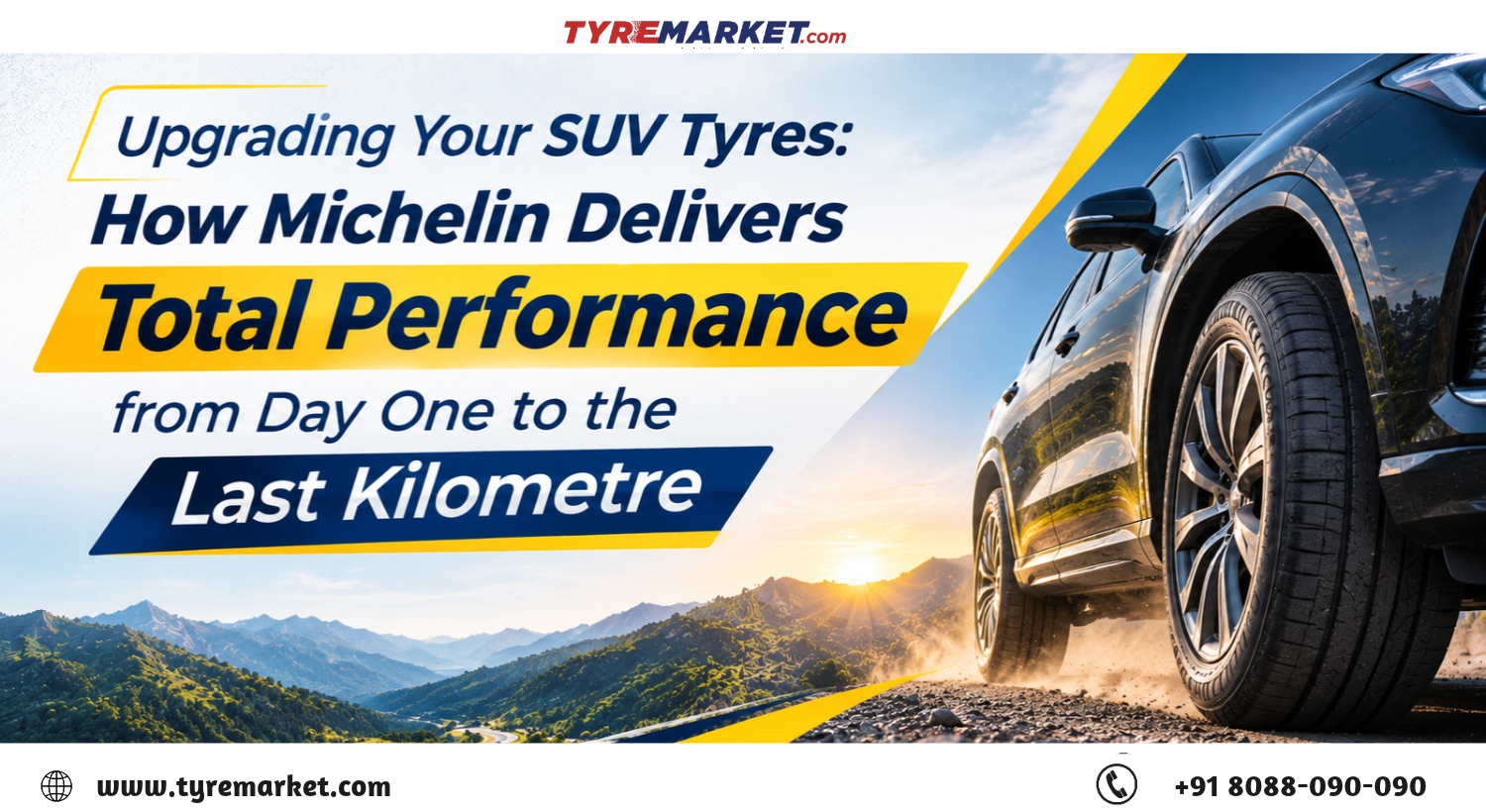
Upgrading Your SUV Tyres: How Michelin Delivers Total Performance from Day One to the Last Kilometre
Key Takeaways
- The first few thousand kilometres rarely tell the whole story about a tyre. For an SUV owner, the real test is how it brakes and grips at 30,000 km, on a wet highway, with the family on board.
- Michelin tests its tyres worn down to 2 mm as well as new. In Indian testing, the Primacy 5’s wet braking lead over rival tyres grew from 8.1 m to 8.9 m as the tread wore.
- Full-depth sipes, U-shaped grooves, and MaxTouch Construction are designed to maintain wet grip and even wear throughout the tyre’s life.
- From a Creta or XUV 7XO to a Fortuner or BMW X3, Michelin has a specific SUV tyre for every use: Primacy 5, Primacy SUV+, Pilot Sport 4 SUV, or LTX Trail.
Fit a fresh set of tyres to any SUV and the first drive home feels great. The steering is crisp, braking is reassuring, and the cabin is calm. That first impression is what most buyers judge a tyre on, and it’s also the least useful thing to judge it on.
The more useful question is how the same tyres will feel two years later. Picture a July downpour on the Mumbai–Pune Expressway with the tread half gone and a full load of luggage in the boot. That is when a tyre earns what you paid for it.
That later stage is where tyre makers increasingly focus their testing. Michelin is one of the brands that publishes braking figures for worn tyres as well as new ones, and those numbers say more about a tyre’s real value than any first drive.
What Does Total Performance Mean for an SUV Owner?
Most tyres are good at one thing. Some have excellent grip but wear out quickly. Others last forever but feel wooden in the wet. Total performance means refusing that trade-off and asking the tyre to handle braking, grip, comfort, longevity, and efficiency together.
For an SUV, that balance is harder to strike. The same vehicle might do a school run in Gurugram traffic on Monday, an expressway run to Jaipur on Friday, and a broken village road on Sunday. A tyre that only suits one of those days is the wrong tyre.
Then there’s time. Michelin’s position is that a tyre’s performance should be judged right down to the legal wear limit, not just in its first few thousand kilometres. Its engineering aims to keep the drop in performance as small as possible as the tread wears.
Why Do SUVs Wear Tyres Differently?
An SUV is harder on its tyres than a similarly sized sedan. It weighs more, sits higher, and usually carries more people and luggage. Every one of those factors adds load on the tyres.
A higher centre of gravity means more weight shifts onto the outer tyres in corners, which wears the shoulders faster. High-torque diesel engines and electric motors also tend to scrub the tread under acceleration. Indian road conditions simply add their own wear through speed breakers, potholes, kerbside parking, and long stretches of coarse concrete.
All of this explains why an SUV tyre needs a stronger structure, and why its performance when worn counts for so much. A heavy vehicle on a worn tyre needs more distance to stop. Every metre a tyre can save in the wet at 25,000 km makes a real difference.
How Does Michelin Test a Worn Tyre?
Most tyre advertising quotes braking figures for brand-new tyres. Michelin also tests its tyres after buffing the tread down on a machine to 2 mm, which is close to the tread wear indicator. It then compares that worn tyre against worn rivals.
The pattern shows up clearly in Michelin’s Indian testing. In an Applus+ IDIADA test at NATRAX in Indore, a Hyundai Creta on 205/65 R16 Primacy 5 tyres was braked from 80 to 20 km/h on a wet surface. With new tyres, it stopped in 30.5 m against a competitor average of 38.6 m.
Worn to 2 mm, the Primacy 5 stopped in 37.6 m, while the rival tyres averaged 46.5 m. The gap widened from 8.1 m to 8.9 m as the tread wore down.
Those figures deserve a closer look. As grooves get shallower, they clear less water, and the risk of aquaplaning goes up. Research shows half-worn treads begin to aquaplane at speeds roughly 5 to 6 km/h lower than full-depth treads.
These figures suggest the Primacy 5 loses less of its grip with wear than rival tyres do. That lead is worth most in the second half of the tyre’s life, which is when most owners are actually driving on it.
Which Technologies Keep the Performance Going?
Long-lasting performance isn’t down to one clever feature. It comes from several design choices working together through the life of the tread.
Grooves and Sipes That Last
On the Primacy SUV+, Michelin’s EverGrip technologies use U-shaped grooves and full-depth sipes. A conventional sipe is shallow, so it wears away early. A full-depth sipe runs to the bottom of the tread. Michelin says the grooves and sipes together “continue to break through the water film on the road even when worn”.
Even Wear Under Load
The Pilot Sport 4 SUV uses MaxTouch Construction, which Michelin says “evenly distributes forces of acceleration, braking and cornering”. That even spread stops one area of the tread, usually the outer shoulder on an SUV, from wearing out before the rest. A tyre that wears evenly lasts longer and also behaves more consistently through its life.
Toughness for Rough Roads
The LTX Trail is designed for SUVs that leave the tarmac. Its RallyForce2 tread compound and Duo-Harmony blocks resist cutting and chipping on rough surfaces. The tread also uses variable-thickness sipes, which further aid performance both on- and off-road.
Matching the Right Michelin to Your SUV
SUVs in India cover a wide range, from compact family crossovers to body-on-frame seven-seaters. The table below shows where each Michelin fits.
| Tyre | Best suited to | Key strength | Rim range (India) |
| Michelin Primacy 5 | Crossovers, SUVs, EVs | Comfort, wet braking new and worn | 16 to 22 inch |
| Michelin Primacy SUV+ | Mid-size and family SUVs | Wet grip from full-depth sipes | 17 to 19 inch |
| Michelin Pilot Sport 4 SUV | Premium and performance SUVs | Dry grip, steering precision | 17 to 22 inch |
| Michelin LTX Trail | Body-on-frame SUVs, mixed use | Tread life, low noise, light off-road | 17 to 18 inch |
For the popular family SUVs, such as top-spec versions of the Hyundai Creta, Kia Seltos, or Mahindra XUV 7XO, the Primacy family makes the most sense. The Michelin Primacy SUV+ comes in 17- to 19-inch sizes that cover much of this segment. Sizes of 18 inches and above also get Michelin’s Premium Touch velvet finish on the sidewall, which is a nice detail on a premium car.
Premium SUVs are a different case. The Michelin Pilot Sport 4 SUV is an OE fitment for AMG, BMW, Land Rover, Mercedes-Benz, and Volvo, among others. On a BMW X3, Mercedes-Benz GLC, or Volvo XC60, it gives the sharp steering those cars were designed around.
Body-on-frame SUVs like the Toyota Fortuner and MG Gloster need a tougher tyre. The Michelin LTX Trail covers 17- and 18-inch sizes and suits owners who spend most of their time on highways with the occasional trail.
Is It Worth Upgrading From Your Factory Tyres?
Carmakers choose factory tyres for many reasons, including cost, rolling resistance, and supply across hundreds of thousands of cars. The first replacement is the owner’s chance to pick a tyre for how it performs over its whole life, not just for a showroom spec. Stick to the size and the load and speed ratings printed on the door placard, and the change is straightforward.
The cost also looks different over a tyre’s life. A tyre that lasts longer and keeps its grip down to the wear indicators needs replacing less often. Michelin also points out that avoiding early replacements cuts the energy, raw materials, and CO₂ that go into making new tyres.
Getting to the Last Kilometre
Even the best-engineered tyre needs some care to reach its full life. A few habits make a big difference on an SUV.
- Check pressures monthly with the tyres cold. Many SUVs list a higher pressure on the placard for a fully loaded car, so use that figure before a long family trip.
- Rotate the tyres every 8,000 to 10,000 km. SUVs tend to wear the front shoulders faster, and rotation spreads that wear evenly across all four tyres.
- Get the alignment checked after a hard pothole hit or a kerb strike. A misaligned SUV can wear the inner edge of a tyre down to the cords while the outer edge still looks healthy.
- Finally, learn where the tread wear indicators are. These small raised bars in the main grooves sit at 1.6 mm. When the tread is level with them, the tyre has reached the end of its life.
Final Thoughts
Buying tyres for an SUV is easy to get wrong because the mistake doesn’t show for months. A tyre that impresses on day one can feel very different by the third monsoon.
That later stage is where Michelin has put much of its testing effort. It tests tyres worn as well as new, uses grooves and sipes designed to work down to the bottom of the tread, and builds tyres that wear evenly under a heavy SUV. For owners who keep their SUVs for years and drive them in every season, that is the performance that counts.
FAQs
- Which Michelin tyre is best for a mid-size SUV like the Creta or XUV 7XO?
The Michelin Primacy SUV+ is the best Michelin choice for most mid-size family SUVs. It focuses on wet braking that holds up as it wears and comes in 17- to 19-inch sizes. The Primacy 5 is also designed for SUVs and comes in 16- to 22-inch sizes.
- Do Michelin tyres perform well when worn?
Yes, Michelin tyres are tested for performance when worn. Michelin buffs its tyres down to 2 mm tread depth and compares them against worn rivals. In testing at NATRAX in India, the Primacy 5 stopped 8.9 m shorter in the wet than the competitor average when worn to 2 mm.
- Which Michelin tyre suits a body-on-frame SUV like the Toyota Fortuner?
The Michelin LTX Trail is the right Michelin tyre for a body-on-frame SUV like the Toyota Fortuner. Its RallyForce2 tread compound is built for longer tread life on both paved and unpaved roads, and it suits owners who drive mostly on highways with the occasional trail.
- Is the Michelin Pilot Sport 4 SUV good for daily driving?
Yes, the Michelin Pilot Sport 4 SUV works well for daily driving on premium SUVs. It’s a high-performance tyre with strong dry grip and wet braking, and its MaxTouch Construction helps it wear evenly. It’s also original equipment on SUVs from BMW, Mercedes-Benz, Land Rover, and Volvo.
- When should I replace my SUV tyres?
You should replace your SUV tyres when the tread wears down to the tread wear indicators, which sit at 1.6 mm in the main grooves. Replace them earlier if you see cuts, bulges, or uneven wear caused by alignment problems.
- Can I upgrade to a different tyre size on my SUV?
It’s best to stay with the size, load index, and speed rating shown on your SUV’s door placard. A different size can affect speedometer accuracy, ride quality, and how the safety systems behave. When upgrading, change the tyre model and keep the size.